
Discover the cars at the Salon des Automobiles Pionnières
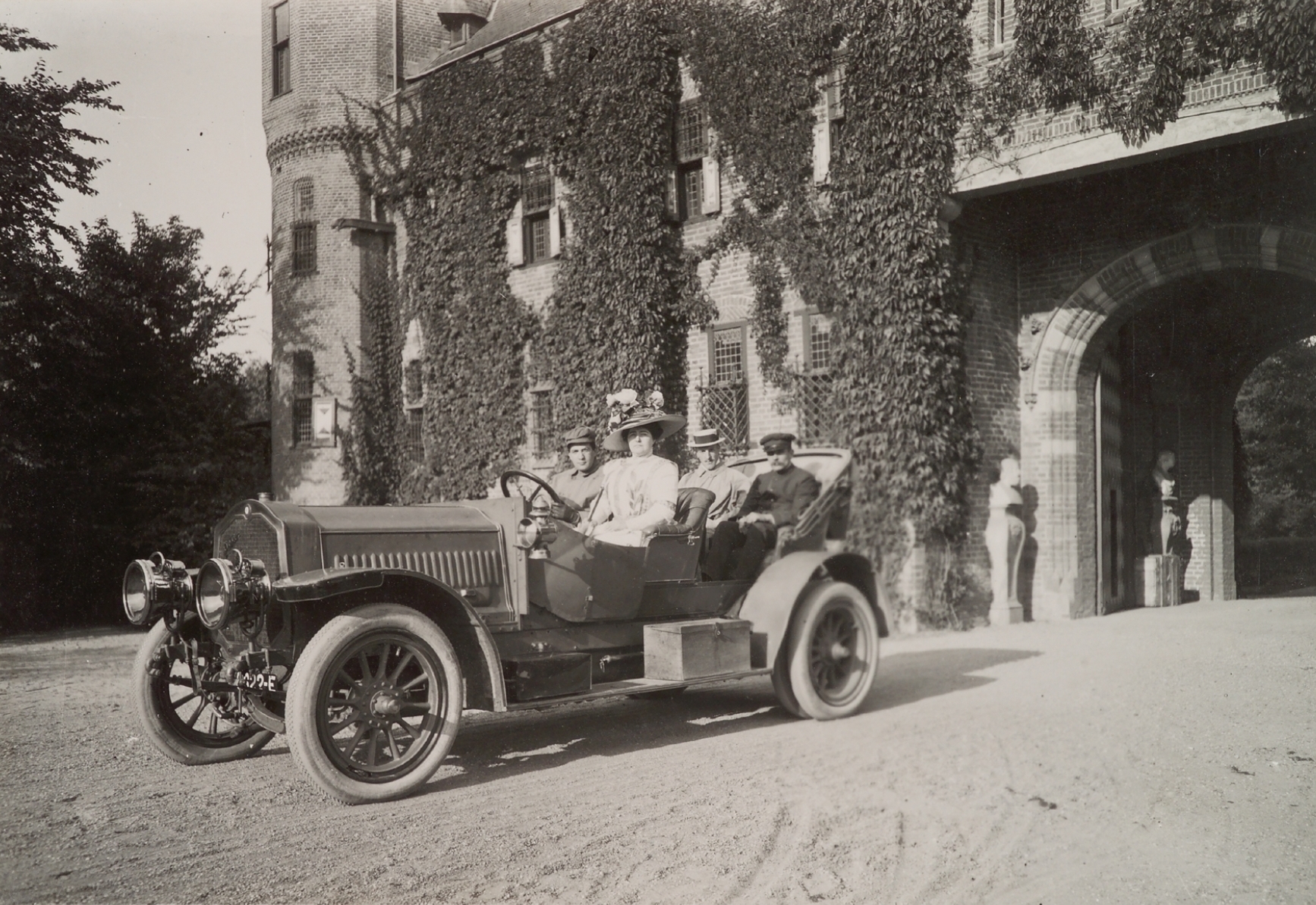
During Salon des Automobiles Pionnières On Saturday, September 19, and Sunday, September 20, unique automobiles from the pioneering years of motoring will be on display at De Haar Castle.
From a rugged 1908 International Harvester to elegant and innovative automobiles from the 1920s and 1930s: each vehicle tells its own story. Stories of technical progress and changing ideas about travel and comfort, but also about the people who built, drove, restored, and preserved these cars.
Discover below the stories behind the cars on display during Salon des Automobiles Pionnières Come to De Haar.
International Harvester Auto Wagon Model AA – 1908
This 1908 International Harvester Auto Wagon Model AA is one of the first trucks produced by the American brand International Harvester. Since 1902, the company had been best known as a manufacturer of agricultural machinery and tractors. With the Auto Wagon, it took its first steps toward producing commercial vehicles.
In 1907, International Harvester first introduced the Auto Buggy, a so-called four-seater High Wheeler Runabout. A year later, the first truck followed: the Auto Wagon Model AA. The second “A” in the model designation stood for air-cooled, a reference to the air-cooled engine.
And that engine was quite something: a 6-liter two-cylinder with about 14 pk. Its simple and robust construction made the car particularly well-suited for farm work on the flat, dry, and dusty prairies of North America.
Yet the Auto Wagon was surprisingly versatile. With an extra bench in the back of the cargo area, it could even be used on Sundays for a family trip to church. The advertising slogan For Farm and Sunday Use It fit in perfectly with that.
Specifications
Bouwjaar
1908
Origin
United States
Engine
6-liter two-cylinder, air-cooled
Power
approx. 14 pk
Gears
2 forward, 1 reverse
Productieperiode
1908–1911
Ford Model T – 1914
This 1914 Ford Model T is a classic example of the so-called Brass Era, the “brass or copper age” of the automobile. The hand-polished brass radiator, large headlights, and other brass details give the car its distinctive look. This early Model T clearly illustrates how different an automobile looked at the beginning of the 20th century.
1914 was also an important year in Ford’s history. During this period, the assembly line was introduced on a large scale, leading to a sharp increase in production and making the Model T accessible to an ever-wider audience. Shortly thereafter, many of the brass trim pieces were phased out, and Ford opted for less expensive black steel.
Under the hood lies a robust 2.9-liter inline four-cylinder engine producing 20 pk. The planetary gearbox has two forward gears and one reverse gear and is operated by three foot pedals. The top speed is around 65 km/h.
This particular car was fully restored in the 1990s and was brought to the Netherlands from Canada in 2012. The car certainly isn’t sitting idle: it’s still regularly taken on road trips of about 100 kilometers. And every year, it takes on a special mission. In Hilversum, this historic Ford takes great pleasure in transporting Sinterklaas.
Specifications
Year of manufacture
1914
Motor
2.9-liter inline four-cylinder engine
Power
20 pk
Top speed
approx. 65 km/h
Gearbox
Planetary gearbox
Gears
2 forward, 1 reverse
Mathis Type M – 1920
This 1920 Mathis Type M is a fine example of the French vision of a lightweight and affordable automobile. Designer and entrepreneur Émile Mathis developed the Type M shortly after World War I. His guiding principle was clear: above all, a car had to be lightweight. His motto was therefore: “Weight is the enemy.”
Under the hood lies a 995 cm³ four-cylinder side-valve engine, producing approximately 15 pk. Weighing only about 650 kilo, the Mathis could reach speeds of about 60 to 70 km/h, depending on the model. The four-speed transmission was remarkably modern for its time. The drum brakes acted exclusively on the rear wheels, a design that was still commonly used in the 1920s.
This Mathis was imported from France to the Netherlands in 1976. The car still features the striking colors that were characteristic of the fashion of that era. Color combinations were often bold: green and blue, for example, were paired with red leather upholstery, while yellow was often combined with black. This Type M has a black leather interior that complements the body’s color scheme beautifully.
With its light weight, modest power, and surprisingly modern technology, the Mathis clearly illustrates how designers after World War I sought ways to make cars simpler, lighter, and more affordable.
Specifications
Year of manufacture
1920
Motor
995 cm³ four-cylinder side-valve engine
Power
approx. 15 pk
Top speed
approx. 60–70 km/h
Weight
approx. 650 kg
Gearbox
4-speed
Bentley 3-Liter Boattail – 1924
This sporty 1924 Bentley 3 Litre is styled as an elegant Boattail, modeled after the 3 Litre Mulliner built for Elisabeth Nagle. The design exudes the spirit of the legendary Bentley Boys: the group of drivers and enthusiasts who brought the brand great fame in the 1920s.
Elisabeth Nagle was not only a race car driver but also a writer. In her book The Other Bentley Boys She highlighted the often-forgotten mechanics and technicians behind the drivers. Their knowledge and craftsmanship were crucial to Bentley’s performance. In the 1920s, the brand won the 24 Hours of Le Mans no fewer than five times.
Under the hood lies a 3-liter four-cylinder engine, equipped with various modifications to improve performance. With about 80 pk and a top speed of approximately 145 km/h, this Bentley was a very fast sports car for its time.
The combination of the powerful engine, the lightweight Boattail body, and the sporty modifications clearly demonstrates why the 3 Litre played such an important role in Bentley’s heyday.
Specifications
Year of manufacture
1924
Motor
3-liter four-cylinder
Power
approx. 80 pk
Top speed
approx. 145 km/h
Bodywork
Boattail
Chevrolet AB National Coach – 1928
This 1928 Chevrolet AB National Coach is a distinctive two-door sedan from the early years of American mass production. Under the hood is a 3-liter engine that produces about 35 pk. This made the Chevrolet a spacious and relatively powerful car for its time.
The car was imported from Denmark to the Netherlands around 1972. In Denmark at that time, people tended to drive used cars for relatively long periods, partly due to the high taxes on new cars. As a result, cars like this Chevrolet remained on the road longer before they eventually made their way to the Netherlands.
In 1975, the car was fully restored. Since then, it has been a member of the Pionier-Automobielen Club. In 2013, the engine was also completely overhauled.
What makes it truly special is the personal story behind the car. This Chevrolet has become a true family heirloom: three generations of the same family have used it as a wedding car. This makes the AB National Coach not only a historic automobile, but also a vehicle connected to important moments in the family’s history.
Specifications
Year of manufacture
1928
Bodywork
Two-door sedan
Motor
3-liter
Power
approx. 35 pk
To the Netherlands
ca. 1972
Restoration
1975
Austin 7 Chummy – 1929
This charming 1929 Austin 7 Chummy was built in Longbridge, Birmingham, and is a magnificent example of the small British car that changed the face of motoring forever. The Austin 7 was produced from 1922 to 1939 and became one of the most important compact cars of its time. It’s no wonder it earned the affectionate nickname Baby Austin.
The name “Chummy” refers to the cozy interior, where passengers sat close together. Under the hood is a 747 cm³ four-cylinder side-valve engine, mated to a four-speed manual transmission. Thanks to its light weight, the Austin 7 was fuel-efficient, affordable, and easy to drive.
Its success wasn’t limited to Great Britain. The design was produced under license as, among others, the BMW Dixi in Germany, the Rosengart in France, and the American Austin/Bantam in the United States. In Japan, too, the Austin 7 served as an important source of inspiration for the development of early small cars.
This car has been in the same owner’s possession for 35 years now. That makes it not only a special piece of automotive history, but also a classic with a personal story.
Specifications
Year of manufacture
1929
Built in
Longbridge, Birmingham
Motor
747 cm³ four-cylinder side-valve engine
Gearbox
4-speed
Austin 7 Production
1922–1939
Chevrolet Series AC International Coupé – 1929
This 1929 Chevrolet Series AC International Coupé marks an important moment in Chevrolet’s history. Under the slogan A Six for the Price of a Four The brand introduced a six-cylinder engine for just ten dollars more than the existing four-cylinder model. It turned out to be a huge sales success: in just thirteen months, more than 1.3 million units were built.
Under the hood lies the well-known 3.2-liter Stovebolt Six, producing approximately 46 pk. The engine earned its nickname because of the resemblance between the bolts on the engine block and simple bolts used for wood-burning stoves at the time. The design proved to be exceptionally reliable and served as the basis for Chevrolet six-cylinder engines until 1962. Toyota also used this Chevrolet engine as the basis for the development of its early Type A engine.
The sporty two-door coupe combines a compact body with the elegant styling of the late 1920s. Its construction featured a combination of wooden parts and steel panels, characteristic of cars from this period.
This car also has an international history. A Belgian enthusiast restored the Chevrolet with great care, and the car has been registered in the Netherlands since 2025.
Specifications
Year of manufacture
1929
Motor
3.2-liter inline six-cylinder engine
Power
approx. 46 pk
Gearbox
3-speed
Original Price
Starting at $595
Dutch license plate since
2025
Rolls-Royce Phantom I – 1929
This impressive 1929 Rolls-Royce Phantom I features a unique Boattail body built by Tony Robinson in London. In the 1920s and 1930s, it was common for prestigious automakers such as Rolls-Royce to supply their chassis to specialized coachbuilders. This allowed customers to have a car fitted with a body designed entirely to their own specifications.
Under the long hood lies an impressive 7.6-liter inline six-cylinder engine. As was traditional for Rolls-Royce, the exact power output was not specified. When asked how much power a Rolls-Royce had, the famous reply was: “Enough”. It was in line with the brand’s philosophy, in which comfort and effortless performance were more important than numbers.
The Phantom I was one of the most prestigious cars of its time. With its large engine, generous dimensions, and heavy weight, the car was designed primarily for comfort, smoothness, and a relaxed driving experience. Yet, with a top speed of about 145 km/h, it was by no means slow.
The long hood, elegant boattail body, and imposing proportions make this Rolls-Royce a striking example of British automotive art from the 1920s.
Specifications
Year of manufacture
1929
Motor
7.6-liter inline six-cylinder engine
Power
Not specified by Rolls-Royce
Top speed
approx. 145 km/h
Bodywork
Boattail
Coachbuilder
Tony Robinson, London
Packard Cabriolet Type 733 – 1930
This elegant 1930 Packard Cabriolet Type 733 epitomizes American automotive luxury from the early 1930s. From 1899 to 1958, Packard was one of the most prestigious American car brands, building cars renowned for their quality, engineering, and style. The famous slogan Ask the owner This underscored confidence in the brand.
Under the hood lies a powerful inline-eight-cylinder engine. For its time, the Packard was technically very advanced. Among other features, the car has a central lubrication system, an overdrive, and a four-speed transmission.
First gear was extra low and was referred to in the sales catalog at the time as the “ladies’ gear,” intended to make maneuvering easier. A typical term from that era that would undoubtedly spark quite a reaction today.
With a price tag of about $2,550, the Packard was a true luxury car in 1930. By comparison, a Ford Model A cost about $495. The price difference clearly illustrates the position Packard held within the American automotive industry.
The current owner is only the third owner. Together with others, he spent several years carefully restoring the car.
Specifications
Year of manufacture
1930
Motor
Eight-cylinder inline engine
Gearbox
4-speed
Technology
Central lubrication and overdrive
Packard Type 733 Standard Eight Sedan – 1930
This impressive 1930 Packard Type 733 Standard Eight Sedan is a true American luxury car. With room for as many as seven passengers, it was one of those cars where comfort, space, and quality took precedence over compact dimensions.
Under the hood is a 5.2-liter eight-cylinder engine, producing approximately 110 pk. The engine is mated to a four-speed transmission with an extra-low first gear and is started electrically. The electrical system operates on 6 volts.
Weighing approximately 2,290 kilograms, with 20-inch wheels and a fuel tank holding no less than 95 liters, this Packard is an imposing sight. The four drum brakes are mechanically operated: the front brakes with cables and the rear brakes with rods.
Another unique feature is the central lubrication system. The driver could manually operate the entire system while driving. Because this caused oil leaks in practice, the system was later modified.
The new price in 1930 was about $2,500, which was roughly six times the price of an average car such as the Ford Model A at the time. Approximately 12,531 Type 733s were produced.
Specifications
Year of manufacture
1930
Motor
5.2-liter eight-cylinder
Power
approx. 110 pk
Weight
approx. 2,290 kg
Number of passengers
7
Fuel tank
95 liters
Ford Model A Phaeton – 1930
This 1930 Ford Model A Phaeton was built in Dearborn, Michigan, and represents an important period in the development of the American automobile. The Model A was produced from 1927 to 1932 and succeeded the legendary Model T. With approximately five million units built, this model also became a worldwide success.
The Phaeton is a four-door open touring car, designed for comfortable travel with multiple passengers. In good weather, the car could be driven with the top completely down, while the windshield and fabric roof provided protection from the elements.
Under the hood is a 3,286 cm³ four-cylinder side-valve engine producing approximately 40 pk, mated to a three-speed manual transmission. The brakes were also modern for their time: the Model A was equipped with mechanically operated drum brakes on all four wheels.
Compared to the Model T, the Model A represented a clear step forward, with a more powerful engine, a more modern chassis, a more contemporary appearance, and four-wheel brakes.
This Ford Phaeton has been owned by its current owner since May 28, 2026.
Specifications
Year of manufacture
1930
Built in
Dearborn, Michigan
Motor
3,286 cm³ four-cylinder side-valve engine
Power
approx. 40 pk
Gearbox
3-speed
Brakes
Mechanical drum brakes on all four wheels
Ford Model A Cabriolet 68B – 1930
This 1930 Ford Model A Cabriolet 68B has been in the same family for over sixty years. What once began as a true barn find, has been transformed into a fully restored classic car. The restoration was largely carried out by father and daughter themselves. This makes this Ford more than just a car: it has brought people together, both during the restoration and during the many kilometers driven in it today.
Ford kept meticulous records of production. The numbers on the engine block and chassis show that these parts still belong together. The upholstery and color combination are also original to this model and year of manufacture. The vermilion red of the rims and trim provides a striking contrast to the purplish Ford Maroon and fits perfectly with the atmosphere of the Charleston and jazz era.
The Cabriolet 68B was produced only in 1930 and 1931 and is one of the rarer models. The straight windshield and roll-up windows combine the comfort of a closed car with the freedom of a convertible.
And there’s another surprise waiting in the back: the so-called rumble seat, a fold-out seat for two additional passengers. It is accessible via steps on the bumper frame and fender. As the owner himself aptly sums it up: “A mother-in-law has to be flexible!”
Specifications
Year of manufacture
1930
Model
Ford Model A Cabriolet 68B
Production 68B
1930–1931
Additional seating
2 in the rumble seat
Special Feature
In the same family for over 60 years
Chevrolet Independence Series AE Special Sedan – 1931
This Chevrolet Independence Series AE Special Sedan was built in January 1931 at the Chevrolet factory in Oakland, California. With its modern design, spacious interior, and powerful six-cylinder engine, it offered an attractive alternative to the popular Ford Model A.
Under the hood lies the famous Stovebolt Six: a 3.2-liter inline six-cylinder engine with about 50 pk. Chevrolet used the slogan Six for the price of a Four. The car has rear-wheel drive, a three-speed manual transmission, and mechanical brakes on all four wheels. A striking feature is the two spare wheels mounted on the front fenders.
The Chevrolet was likely built in the 1980s or 1990s by an enthusiast in California from a collection of parts. In October 2019, the car arrived in the Netherlands after the current owner purchased it online from the United States without ever having seen it in person.
Since then, the Chevrolet has covered many kilometers, including during the Elfstedenrally, the Antwerp Concours d’Elegance, drives through the German border region, and countless family and leisure trips.
As the owner describes it: no trailer queen...but a classic that’s still on the road. This Chevrolet was built to drive—and it still does.
Specifications
Year of manufacture
1931
Built in
Oakland, California
Motor
3.2-liter inline six-cylinder engine
Power
approx. 50 pk
Gearbox
3-speed
Powertrain
Rear-wheel drive
Austin Seven AF Tourer – 1931
This compact 1931 Austin Seven AF Tourer was built by The Austin Motor Company in Longbridge, Birmingham. The AF Tourer was a four-seater open touring car and was produced around 1930–1932. With its small dimensions, this Austin is a striking example of the affordable and practical British car from the early 1930s.
Under the hood is a 747 cm³ four-cylinder side-valve engine, producing about 10 pk. With this engine, the Austin reaches a top speed of about 82 km/h and achieves a fuel economy of approximately 1 on 16. With a wheelbase of just 1.90 meters and a total length of 2.89 meters, it is a strikingly compact car.
Between 1922 and 1939, a total of 290,944 Austin Seven Saloon and Tourer models were produced in Great Britain. According to information provided by the owner, 119 of these cars are still registered in the Netherlands.
This Austin was brought to the Netherlands from England in 1991. In 2022, it ended up with its current owner—actually by chance, while he was searching for a Solex. So that search took an unexpected turn.
Specifications
Year of manufacture
1931
Motor
747 cm³ four-cylinder side-valve engine
Power
approx. 10 pk
Top speed
approx. 82 km/h
Length
2.89 meters
Number of seats
4
Want to see the cars for yourself?
The cars will be on display during the Salon des Automobiles Pionnières on Saturday, September 19, and Sunday, September 20, from 12:00 PM to 4:00 PM on the picnic lawn at De Haar Castle.
Not every car will be on display on both days. Be sure to check the program in advance to find out which cars will be on display on Saturday and which on Sunday.